Claw Marks on the Sea
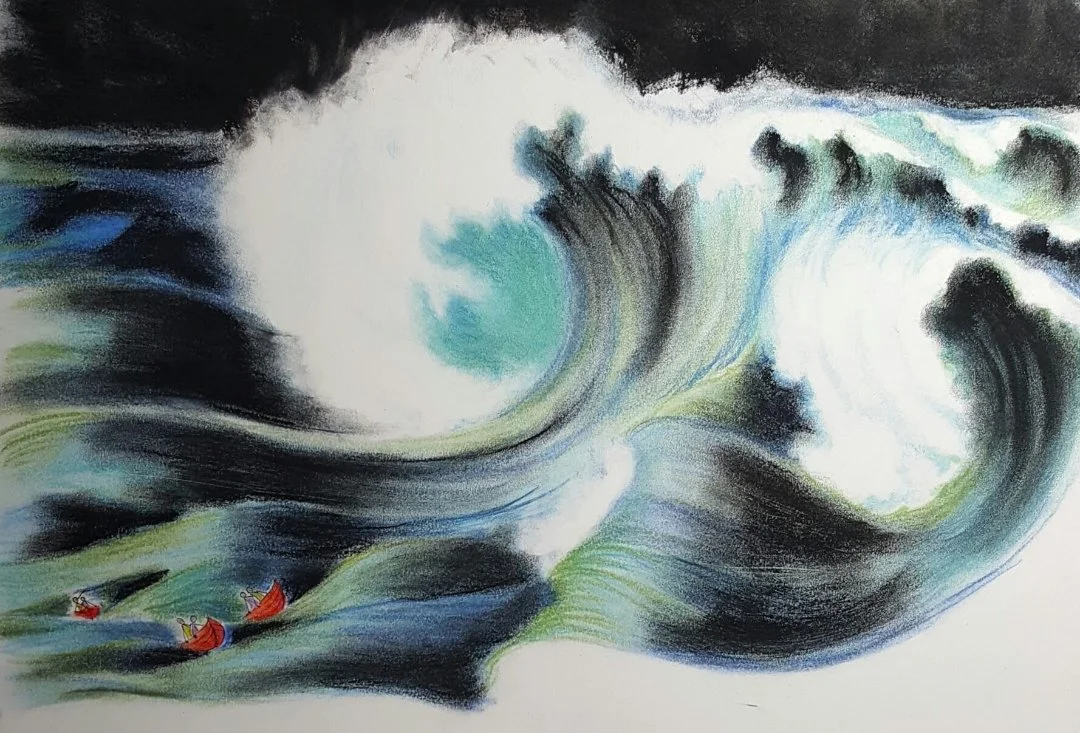
Same Storm, Different Boats (chalk pastel on paper)
Two little tidbits from the interwebs collided the other day. The first was from Anne Lamott who said this in The Corners newsletter:
“I heard early on in my recovery that everything we let go of has claw marks on it.”
The second was an article in the beautiful Nautilus Magazine that informed me that the water on the Earth is older than the Earth itself (having traveled here from distant stars in the shimmering tails of comets and the streaking fire of meteors) and that the water at the bottom of the sea can take 1000 years to cycle to the top (“What Poseidon is Telling Us,” Kate Marvel).
This collision got me thinking about art and time and letting go.
Lamott’s image is a useful one. It captures my own tendency to cling to things, even and especially things that aren’t good for me, like a career I can no longer do well, or a self-conception that I use as a measuring stick for my current worthiness and value. Oh, I say to myself, I used to be able to do this thing ten years ago. If I just keep pushing I will be that blythe and lithe beauty again! I can’t stop looking at that poor woman, this ghost trapped in a mirror.
It’s an endless recursion of longing.
But here’s the thing: she is not me. I would have about as much luck turning myself into, I dunno, a primordial bacterium as “getting back” to who I used to be. There are too many steps along the evolutionary path that cannot be erased or elided. And, besides, if I could go back to that woman of ten years ago, I would encounter a woman who was lamenting that she was no longer what she was ten years ago. It’s an endless recursion of longing. And, at some point, that blackflow of yearning is going to meet the longing of the ten-year-old who wanted nothing more than to be older, to be independent, to be free.
And that doesn’t even count all the stuff that the universe snatches out of my hands—parents, friends, a smoothly functioning heart muscle, teeth, jobs, good intentions—all these things that abide and erode like waterlogged wood. Clawmarks indeed. We live in turbulent waters, thrown forward by desire and back by nostalgia. We cling to things—people, talents, our imagined selves—like life rafts, like debris from a shipwreck of expectation.
I guess the point is that our grip on what we love is not as strong as the pull of time that drags the beloved away from us. And maybe holding on too tightly mars their surfaces and deforms their shapes
But, hold the phone here, lady. Did you not just write a manifesto about how art is all about resisting entropy? Isn’t that the very definition of hanging on tight enough to leave claw marks?
Maybe stuff gotta go, sink deep, make room.
Maybe, but I keep thinking about that ancient water and the thousand-year cycle of depth and surface. Everything is swept along in the current of time, a sort of Gulf Stream responsible for moving warm water to cold places in order to keep life living.. Maybe holding on too tightly gets in the way of bigger life cycles. Maybe stuff gotta go, sink deep, make room.
We are bizarre creatures. We can only sail forward but we can only see what is behind us, what is receding, what is lost. But maybe what looks like a loss is actually a cycle. Water is older than the Earth, and when the Earth goes poof! in the fiery exhalation of our dying sun, the water will go elsewhere and new things will stir and wriggle and eventually wonder if they can fit into that dress they bought on sale before the pandemic and never got to wear.
Does art leave claw marks on passing things? Or does it soothe them?
The artist knows that she can’t stop time or return to what was or recuperate what was lost. Does art leave claw marks on passing things? Or does it soothe them? Some art is a monument to things we’ve let go, or that have been pulled from our grasp. In fact, time and loss are precisely what make art necessary and meaningful. But art is part of that other, longer cycle of making and losing and remaking.
The artist lashes together the pieces, the flotsam and jetsam of our experience, in order to make something seaworthy, but it’s not the same boat that left port ten years or eons ago. It’s never a return. Art is about shaping the remains of the world into a new world. In committing to our art, we kludge the experience of time and yearning into meaning, a little boat bobbing in the ancient sea.