Art and the Heat Death of the Universe
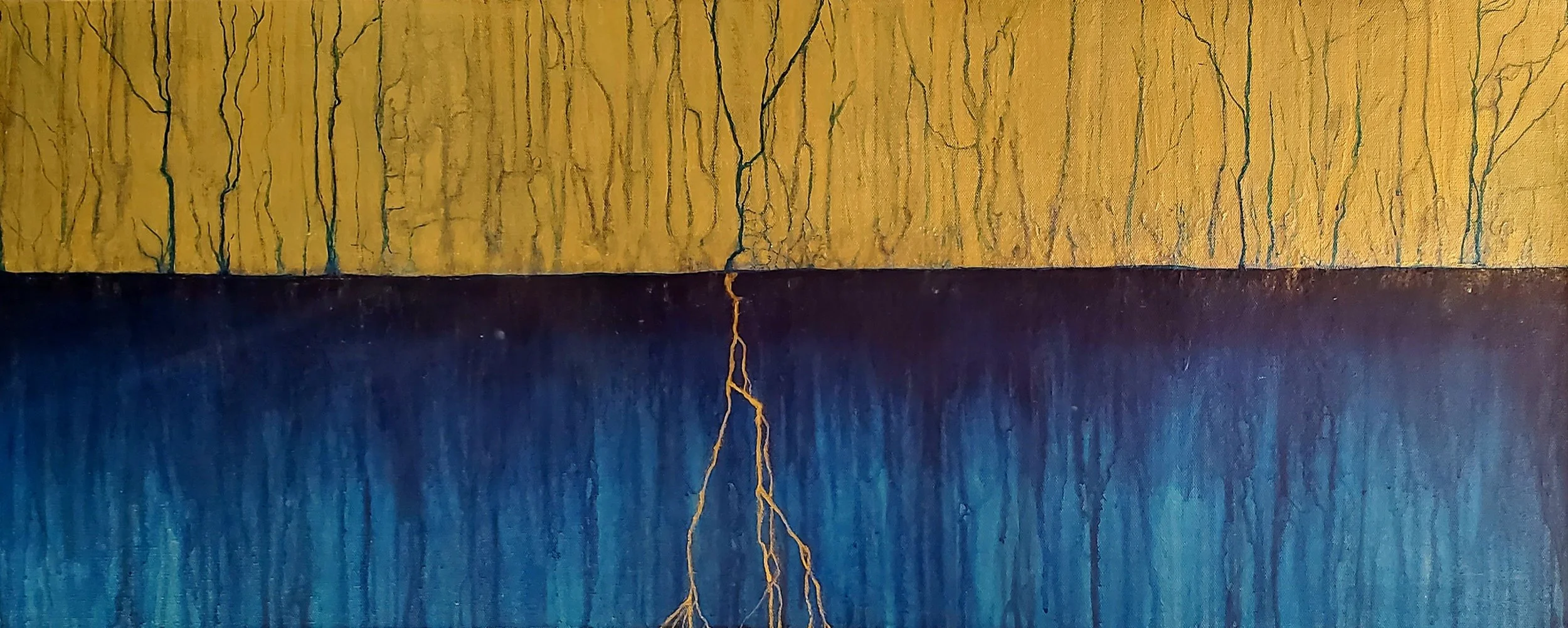
“Closed systems tend toward an equilibrium state in which entropy is at a maximum and no energy is available to do useful work.” (The Second Law of Thermodynamics)
“[W]here there is no administration of objective conditions, no shaping of materials in the interest of embodying the excitement, there is no expression.” (John Dewey, The Art of Expression)
According to the second law of thermodynamics (Wait! Wait! Come back! I promise there’s stuff about art here!), the universe is rolling downhill toward maximum entropy, which means a state of absolute equilibrium where no heat can be exchanged, no energy can move from one place to another, no work can be done. Stillness, homogeneity, inertness. This is why a pot of water will never spontaneously come to a boil and why a pot of boiling water will eventually cool to the temperature of the air around it. The little wind-up dancer in the music box of the cosmos twirls more and more slowly as the twinkling music becomes an intermittent ting… plink… and then nothing at all. Entropy, baby. Stuff just wants to lie down.
Unless.
Energy can be added from somewhere else in the system. Burn some natural gas to heat that water up again. Steal a little bit of chemical energy from our muscles to wind the spring to make the music box dancer twirl. Or, you can add constraints. Put that water into a closed cylinder and make a hydraulic piston. Sure, sure, in the grand scheme of things—the cosmically grand scheme—the universe is a closed system and there is no natural gas line from elsewhere to add energy, so these little moments are at most acts of temporary resistance.
Metaphor is a machine for doing work in the universe.
Which would be depressing if I were talking science here and not metaphor, which is what this is. Metaphor is a machine for doing work in the universe. It takes one thing—in this case thermodynamics—and another thing—art—and jams them together like the two halves of radioactive material in an atomic bomb. Big things happen. Stuff gets shook.
I don’t like the metaphor of the atomic bomb. A mushroom cloud is not what I’m going for here. Maybe, instead of nuclear physics, I should insist on fauna and flora. Making a metaphor is introducing a humming bird to a flower. Nutrients are exchanged, pollen dispersed, things grow.
That’s better.
Sometimes, metaphor can lead you places you didn’t expect to go. It’s tough work, wrangling language. Sometimes the medium of expression resists your efforts and you have to apply more muscle to it or find a different constraint to get it to do what you want.
A baby crying in the night is expressing her feelings but is not an artist.
According to John Dewey, an early 20th-century philosopher, the difference between expression and creativity is work, the application of the will to a resistant medium. A baby crying in the night is expressing her feelings but is not an artist. A baby crying is basically the boiling pot releasing its energy into the air. An artist has to do work: move energy from one place to another (from the flower to the bird, from artist to audience); apply constraints (mixing paint, hammering metal or language into a shape); find an appropriate medium to carry that energy into the world. The artist does “real work” that “evokes, assembles, accepts, and rejects memories, images, observations, and works them into a whole” (Dewey, The Art of Expression, 1934).
The process, the act of struggling, is part of the object. The work is both a noun and a verb.
The artist makes a work. That work, however temporarily, does work, resists entropy. The work creates changes in its environment by reallocating energy and applying constraints. The artist doesn’t always know in advance what those changes will be, or how the medium will work with her or resist her. Resistance is a necessary quality of art, the way that we can only take a step because the floor resists our weight. We need the medium to have “grippiness,” some texture, some push-back so that we can push off to the next step. Each medium comes with its own kinds of resistance and “grippiness.” In creating things, struggle is not a bug but a feature.
The process, the act of struggling, is part of the object. The work is both a noun and a verb.
The purpose of the work is to jolt us from the equilibrium and inertness of our habitual ways of seeing and being.
It is true that there is nothing new under the sun. The artist has only what is at hand, the already-made stuff of the world. The world exists “before hand,” that is, before she has put her hand to it, and the work exists after she has manipulated it, negotiated with it, changed it, added energy to it, constrained it. Her job is to combine things in unexpected ways (like nuclear physics and hummingbirds) so that the work she does and the work she makes can open up “new fields of experience and disclose new aspects and qualities in familiar scenes and objects” (Dewey). The work of the work is to gather, to combine, to manipulate, to constrain, to reflect, to negotiate, to shape parts into a whole. The purpose of the work is to jolt us from the equilibrium and inertness of our habitual ways of seeing and being, to wind us up, to impel us into motion again.
Ultimately, like Adam and Eve ejected from Paradise, we move through the world of stuff and things and get on with the daily labour of turning sticks into fire, sand into bricks, the blood of bugs and the minerals of the earth into pigments, and pigments into pictures of our hearts. We shore up the downhill slide to equilibrium with the energy of our muscles and hopes.
Art is an act of putting the world together at least as fast as it is falling apart. Art moves energy around the system to get the pot boiling again. Art will not let stuff lie down. Art insists on disequilibrium. Art is a big ol’ middle finger at entropy. Art is resistance to the heat death of the universe.
We are the voice of the universe singing to keep itself awake.